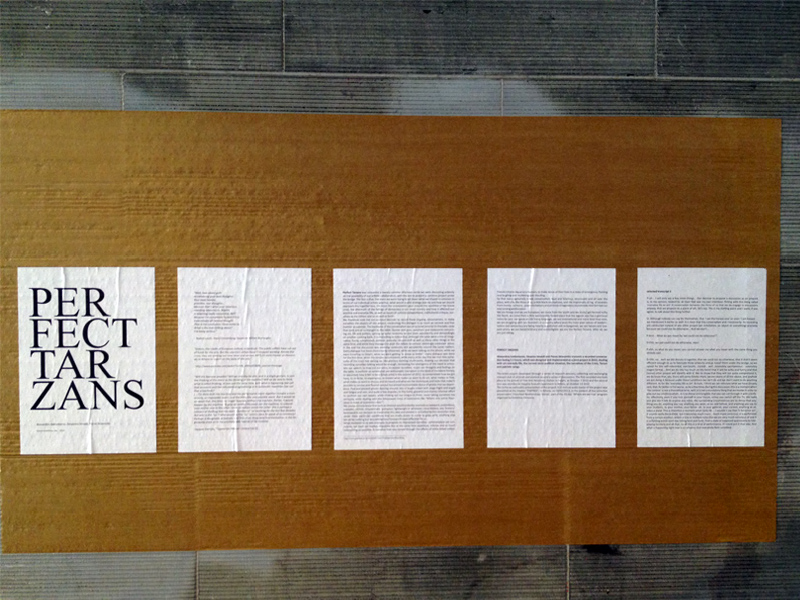
Perfect Tarzans
2012-13
Public installation, lecture performance
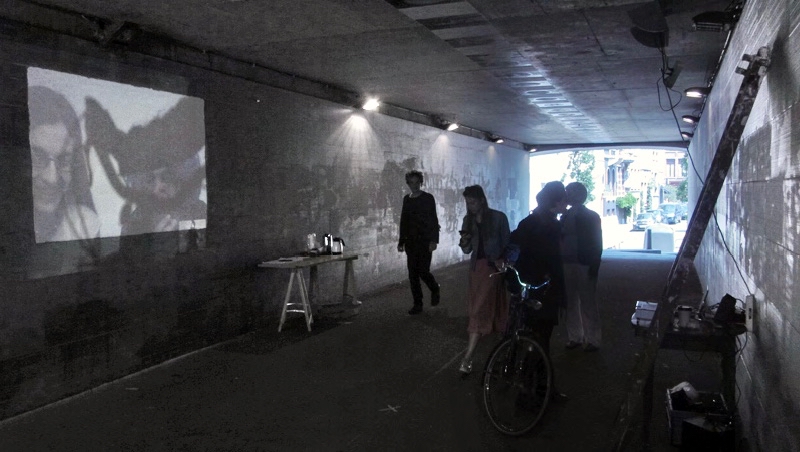
Logo & installation shots at BRDG, Antwerp
Despina Sevasti, Alexandros Kaklamanos and Panos Sklavenitis transmitted at BRDG a recorded conversation in Greek, lasting 3,5 hours, which was designed and implemented as a joint project in 2012.
Perfect Tarzans is dealing with art and daily life in the indebted Greece, the narratives of the Greek Crisis, Tarzan, patriotic songs, Greek neo-nazism, and what it meant to be a young Greek artist in this condition. The entire project developed through a series of research sessions, collecting and exchanging relevant stuff of all kinds and evolved around a series of discussions.
The first recorded session took place at the School of Fine Arts Residency Station in Delphi, on October 7th 2012 and the second recorded session took place at Despina Sevasti’s apartment in Athens, on October 13th 2012.
The 10-minute audio trailer of the project was presented at the theater “EMPROS” in Athens, on the 9th of February 2013, in the context of the collective presentation ‘Disturbed Relationships: Voices’, part of the 10- day ‘Where are we now’ program organized by Kolektiva Omonoia.
Further info: http://perfecttarzans.blogspot.gr/
__________________________________________
Project essay by Despina Sevasti
“Greece, the cradle of European culture, is bankrupt. The public coffers have run out of funds for the arts. But the country’s artists haven’t stopped working. Amidst the crisis, they are seeking out new ideas and venues. ARTS.21 visits theater professionals in Athens to report on the state of the arts.”
Culture in the Crisis – Greek artists grapple with economic collapse | Arts.21
“Will this become possible? Will we one day be able, and in a single gesture, to join the thinking of the event to the thinking of the machine? Will we be able to think, what is called thinking, at one and the same time, both what is happening (we call that an event) and the calculable programming of an automatic repetition (we call that a machine)?
[….T]o think both the machine and the performative event together remains a monstrosity, an impossible event, and therefore the only possible event. But it would be an event that, this time, no longer happens without the machine. Rather, it would happen by the machine. To give up neither the event nor the machine, to subordinate neither one to the other, never to reduce one to the other: this is perhaps a concern of thinking that has kept a number of “us” working for the last few decades. But who is this “us”? Who would be this “us” whom I dare to speak of so carelessly? Perhaps it designates at bottom, and first of all, those who find themselves in the improbable place or in the uninhabitable habitat of the monster.
-Jacques Derrida, “Typewriter Ribbon: Limited Ink (2)
Perfect Tarzans was conceived a sweaty summer afternoon while we were discussing ardently on the possibility of our artistic collaboration, with the aim to present a common project under the bridge. The fact is that, the more we were trying to pin down what we shared in common in terms of our individual artistic practice, what would a valid strategy plan be and how we should approach this togetherness, the more the conversation spun around the condition of the Greek crisis, the aftermath of the failings of democracy in our small country and how it affected our practice and everyday life, as well as issues of cultural juxtapositions, institutional critique, ourselves as the Others and so on and so forth.
We therefore took the not-so-novel decision to record these ongoing conversations, to make ourselves the objects of this project, conducting this dialogue in as much an earnest and free manner as possible. The backbone of the conversation was structured around 10 thematic cards that each one of us brought to the table. Quotes and puns, questions and statements concerning art, life and politics, sprung up quite randomly on one level, persistently and demandingly on another. Looking back, it is interesting to notice that, although the cards were a mix of imaginative, funny, complicated, political, personal, absurd stuff as well as many other things at the same time, and while they managed to push the debate to various- seemingly unrelated- areas, in the end the discussion was evolving constantly and persistently around the same matters.
Every dialogue had been involuntarily rehearsed, while we were talking on the phone, while we were traveling to Delphi, while we were getting ‘to know us better’;
every dialogue was done for the first time, while the tension accumulated, while every other day that we met new symptoms of the crisis had sprung up, like glorious looming mushrooms, shaking our decision that recording ourselves talking would be enough, reinstating the emergency of the need to articulate our speech, to map out our voice, to expose ourselves, to put our thoughts and feelings on the table, to perform an amateurish yet enthusiastic inscription in the book of mundane history, to document how it felt to be a Greek artist in the autumn of 2012, to contemplate how we got here, to re-write, re-experience, re-instate what makes us want to do art, what makes us free, what makes us want to discuss and be heard and what are the techniques and tools that make it possible to survive and flourish amidst this almost inconceivable dance of ghosts that we experience.
Past and present ghosts dancing around, lots of laughs mixed with stage fright and angst and fatigue and zest, and quite a few disputes, in this futile, intense and clumsy informal effort to confront our own beasts, while sticking out our tongue at them, never taking ourselves too seriously, while dealing with the bittersweet irony of statements like “Athens arts scene flourishes in midst of economic crisis”.
We always already knew that such an attempt would probably resonate as awkward, pretentious, cliched, unsystematic, pompous, lightweight or whatever; nevertheless, any ‘bravery’ bestowed to our decision to materialize this idea and present it, is fueled by the conviction that, under these particular conditions that we madly desire to come to grips with, anything else would be nothing but less satisfactory/relevant/honest/effective for us.
What mattered to us was precisely to propose an improvised narrative, commonplace yet convulsive, laid back yet loaded, impulsive but at the same time polemical, intense and as much unassuming as possible. A narrative that was carved through the efforts of three Greek artists-friends-citizens-Aquarians-humans to make sense of their lives in a state of emergency. Panting and laughing and muttering and shouting.
So that was a genuinely Greek conversation, loud and hilarious, structured and all over the place, with only the three of us, a little black microphone, and the impromptu dj’ing of excerpts from movies, cartoons, poem recitations and all kinds of legendary soundtracks that formed our ever-ending adolescence.
We are foreign and we are European, we come from the South and we study/ get formed in/by the North, we come from a little weird/pretty fucked up place that the legend says has a glorious/noble far past, we speak an old funny language, we are international and more local than ever, we are struggling with our monsters in a country where even the most plain values of modernization and democracy are being heavily questioned and re-bargained, we are heroes and low-paid actors, we are banal/ordinary and unintelligible, we are the Perfect Tarzans.
After all, we are just talking.